Essential oils and Pitum Ketoret
David Israel Macht wrote a 1928 book on Temple Incense.
“From a pharmacological point of view incense is especially interesting in two respects. First in regards to is antiseptic properties, secondly, in regard to its effects on the nervous system, and more particularly on the psychological functions, through the sense of smell.”
Robert Tisserand’s Editor Introduction on Gattefosse’s Aromatherapy book writes
“Wound healing was a major problem, and the cause of many deaths during first World War. Essential oils might have been more widely used during the Second World War if penicillin had not been discovered, but they were used to a limited degree – for instance some Australian troops carried tea tree oil, until supplies ran out.”
The World War(WWI) was instrumental,in connection with the impetus given to the search for antiseptics and germicidal properties of various essential oils; as for instance so well described by Cavel. This antiseptic action of volatile oils was un-doubtly responsible for the remarkable medicinal virtues of various balsams used in ancient times, especially in the treatment and healing of wounds.
See Pitum ketoret blend (Shemen sod or Shemen tov)

Avraham Sand writes that
“Since ancient times, natural aromatic plant substances have played a vital role in the daily life of everday folk, in every native culture throughout the world. More recently, over the past few generations, this vital link between people and plants has become diminished, and many of us are losing touch with the earth and our own state of health.
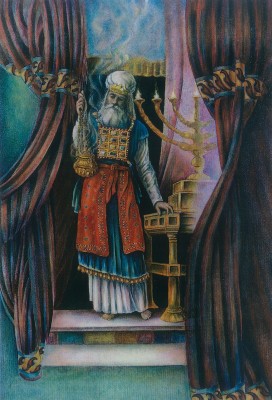
artwork by Yitzhak Ben Yehuda
One native culture, which thousands of years ago based its medicine and religious ceremonies on aromatic plants, has begun to reemerge. After nearly 2000 years in exile, the people of Israel are returning to Jerusalem to rebuild the Temple, and renew its ceremonies. Behind the tumultuous scenes and out of view of the news media, a dedicated group of people are quietly rebuilding the original vessels and instruments, and a number of special schools are training those who will use them.
Central to all of the ceremonies conducted in the Temple was the Incense Offering. It consisted of a precise mixture of 11 Holy Spices, known in Hebrew as the Ketoret Besamim (mentioned in Exodus 30:34-38). During the days of the Temple, the Ketoret is burned every evening and morning on the golden Incense Altar by Cohanim (priests), in front of the Holy Ark in the Communion Tent of the Temple’s Sanctuary.
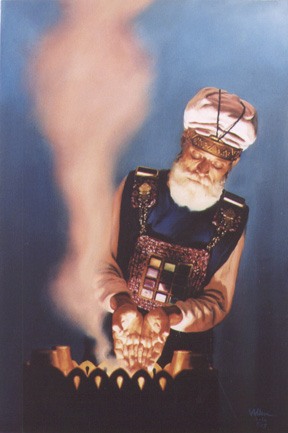
Image Beged Ivri
According to the Zohar, the Incense Offering is the most precious part of the Temple service in the eyes of the Great Spirit, and every Priest hopes to have the honor of conducting this service, which is permitted only as a once-in-a-lifetime opportunity. It is said that one who has had the privilege to offer the Incense is rewarded by the Holy One with wealth and prosperity forever, in this world and in the next.
During the days of the Temple, the exact method of Ketoret preparation by the Master Perfumer was a closely guarded secret. Today we are still unravelling the mystery of exactly which ingredients and processes were used to formulate the finely ground mixture. Although there are still varying opinions and speculation about some aspects of the Ketoret, the wise ones among us have been able to identify the exact botanical sources of the main ingredients.”
Ancient Essential oils
The NAHA writes: Distillation appears to have been practiced throughout ancient times. Based upon the current interpretation Paolo Rovesti’s discovery of an earthenware distillation apparatus, the production or extraction of aromatic oils by means of steam distillation, has been known for 5000 years. During the fifth century AD, the famed writer, Zosimus of Panopolis, refers to the distilling of a divine water and panacea. Throughout the early Middle Ages and beyond, a crude form of distillation was known and was used primarily to prepare floral waters or distilled aromatic waters. These appear to have been used in perfumery, as digestive tonics, in cooking, and for trading.
Although an extensive trade of odoriferous material has been shown to have occurred in the ancient Orient and ancient Israel, Greece and Rome, the oils used were not essential oils per se, “rather they were obtained by placing flowers, roots, and other plant material into a fatty oil of best quality, submitting the glass bottles containing these mixtures to the warming influence of the sun and finally separating odoriferous oil from the solid constituents”.
ויעש את־שמן המשחה קדש ואת־קטרת הסמים טהור מעשה רקח׃
And he made the Moshiach Shemen and the pure Ketoret of sweet b’somim, after the art of the perfumer.
~Shemos 37:29 (Exodus)
It is meritorious to anoint our bodies for healing
because our bodies are a miniature image of the Holy Temple.
We have some amazing Maceration infusions Essential oils that are the Highest Quality oils made using the most ancient process according to ancient Israel techniques. Click picture below for more details

“LET YOU GARMENTS BE WHITE AND LET YOU HEAD LACK NO SHEMEN” Ecc 9:8
_______________________________________________________