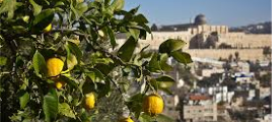
My two sons in the field of strawberry and many other blessings of foods
Rivkah was able to disguise Yaakov superficially, by dressing him in Eisav’s clothing, and placing goat’s hair on Yaakov’s smooth skin, she was not able to disguise Yaakov’s true nature. Yitzchak is confused and distressed by the contrast of a man who physically seems to be Eisav, yet has the personality of Yaakov. His confusion culminates in his troubled declaration, “The voice is the voice of Yaakov, yet the hands are the hands of Eisav! [27:22]”
It is at this point in the drama that an amazing thing happens. Yitzchak beckons Yaakov/Eisav to draw near, kisses him, remarks on his sweet fragrance (“See, the fragrance of my son is like the fragrance of a field that Hashem has blessed!” [27:27]), and then bestows upon him the coveted paternal blessings, thus conferring the lineage of the Jewish nation to Yaakov. The rest, as they say is history.
The reader, however, is left dumbfounded. What ultimately gave Yitzchak the resolve to continue with his blessings, despite his distress and confusion as to who it was that stood before him?
A conservative Rabbi who’s been leading a congregation for many years is upset by the fact that he’s never been able to eat pork. So he devises a plan. He flies to a remote tropical island and checks into a hotel. He immediately gets himself a table at the finest restaurant and orders the most expensive pork dish on the menu.
As he’s eagerly waiting for it to be served, he hears his name called from across the room. He looks up to see ten of his loyal congregants approaching. His luck, they’d chosen the same time to visit the same remote location! Just at that moment, the waiter comes out with a huge silver platter carrying a whole roasted pig with an apple in its mouth. The Rabbi looks up sheepishly at his congregants and exclaims, “Wow, you order an apple in this place – and look how it’s served!”
Rashi (26:34), quoting Chazal, compares Eisav to the pig. Animals require two signs in order to be classified as kosher: split hooves and chewing their cud. The pig has the former, not the latter (see Vayikra 11:3,7). However, unlike other hooved animals, that fold their legs beneath them when they lie down, the pig stretches forth its hooves, as if to say, “See how kosher I am!” So too Eisav went to great trouble to give his father the impression of sincerity and righteousness, all the while committing grave and unforgivable sins. He duped Yitzchak, as it were, by making him “miss the pig for the apple.”
Smell is referred to by Chazal, our Sages, as “something from which the soul takes pleasure.” “From where do we derive,” our Sages ask, “that one must pronounce a blessing over good fragrances? For it is written (Tehillim/Psalms 150:6), ‘Let every soul praise G-d!’ What [thing] gives pleasure to the soul? This refers to smell.” [Talmud, Berachos 43b]
When Yaakov drew near, Yitzchak became aware of his beautiful fragrance. Our Sages say he smelled “like a field of apples,” which is a reference to the Garden of Eden [see Rashi 27:27]. The holy Zohar comments, “The Garden of Eden came in with Yaakov, for it is a field of holy apples.” It was this – the scent of Yaakov – that finally made Yitzchak realize he had been had. Scent is connected to the soul – so if Eisav was indeed a “gem in the rough,” where was the scent? Why was it only now – when this perplexing Yaakov/Eisav character stood before him – that Yitzchak’s spiritually-sensitive sense of smell picked up the fragrance of Gan Eden?
“And he smelled the fragrance… and he said, ‘See, the fragrance of my son – Yaakov, is like the fragrance of a field which Hashem has blessed! And may G-d give you from the dew of the heavens, and the fatness of the earth…’” All along there had been something missing – the “smell of the sincere” – yet it was only now that Yitzchak realized it about Eisav his eldest son lacked.
ENJOYMENT OF THE SOUL
While the blessings on enjoyments are technically of Rabbinic origin, our Sages suggest a Biblical source for the obligation to make a blessing on pleasing fragrances. The verse “All the soul shall praise God” (Tehillim 150:6) teaches us that there is a praise of G-d which belongs to the soul alone. The Sages asks, “What is it that provides enjoyment for the soul, but not for the body? Fragrance” (Berakhot 43b).