Red Everlasting/Red cudweed “Dam haMacabim” The “Drops of Blood” from which hope blossoms
During the seven-week period between Passover and Shavuot, while some flowers of the early spring have begun drying up, blooms the plant Helichrysum sanguineum, in English the Red Everlasting/Red cudweed, called in Hebrew Dam haMacabim, or Blood of the Maccabees. Dam haMacabim belongs to the family of Compositae, the second largest family in the plant world, which includes about 1,000 species, and about 2000 different varieties. Plants of this family are characterized by a dense collection of tiny flowers, clustered together, for example, the Chrysanthemum, the Groundsel and the Anthemis. Some of the flowers in the family are “tubular” and narrow while others are more “tongue-shaped” (with a single tongue-like petal), and are located primarily within the cluster of flowers.
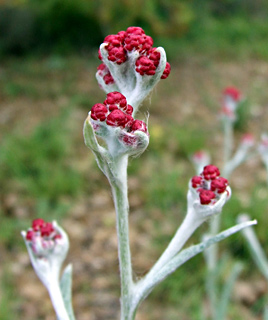
Dam haMacabim, unlike other flowers of the family, contains a collection of yellow tubular flowers, very close together, wrapped in a red cover which we can see, thus giving the flower its characteristic color. These covers which protect the flowers are slow to fade, and remain the color of blood for many weeks and can be preserved. For this reason, this flower is often used around the world for ornamentation. On Mount Hermon in northern Israel is an exceptionally rare form of the flower, the Mountain Dam haMacabim.