


Description
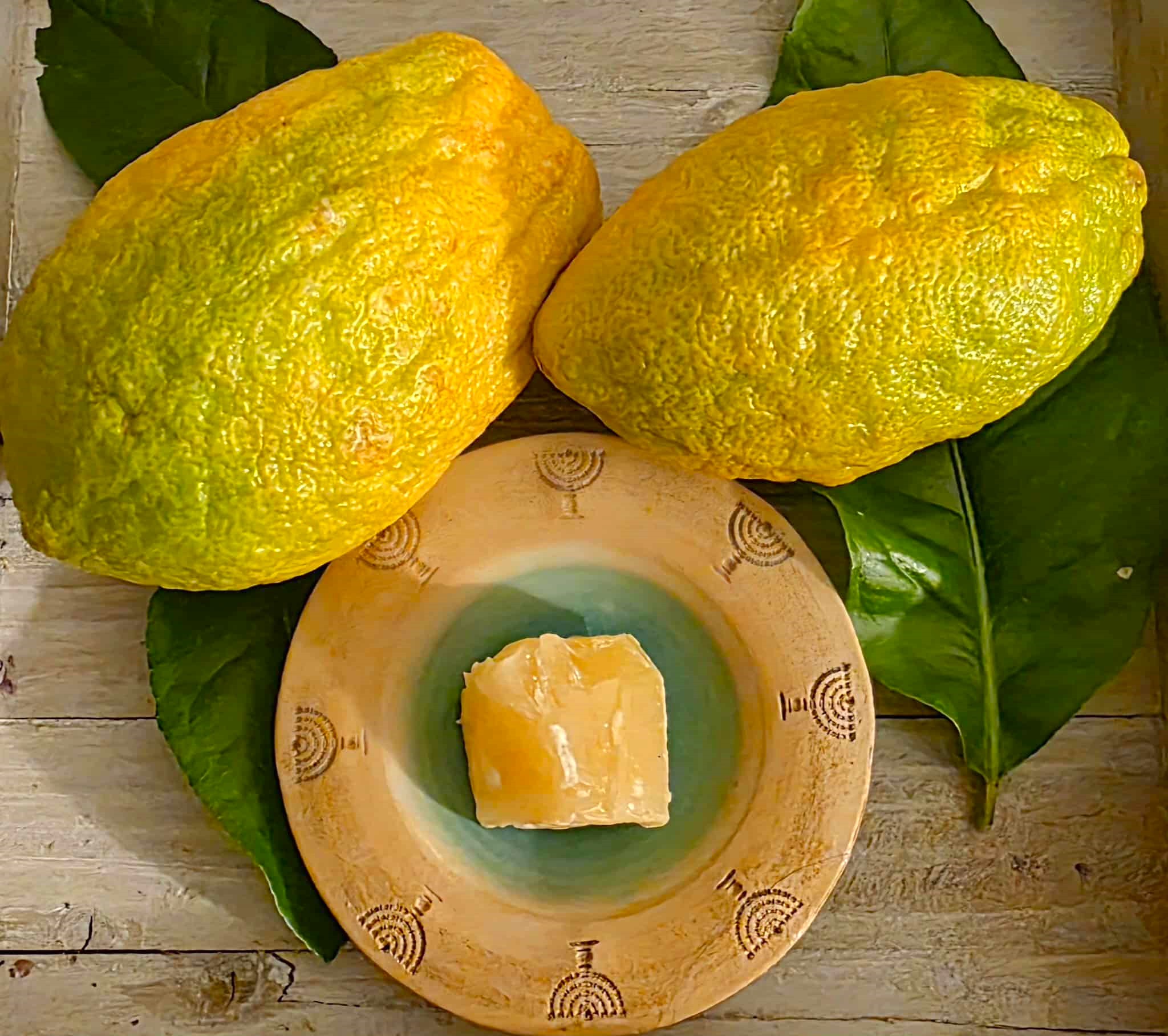
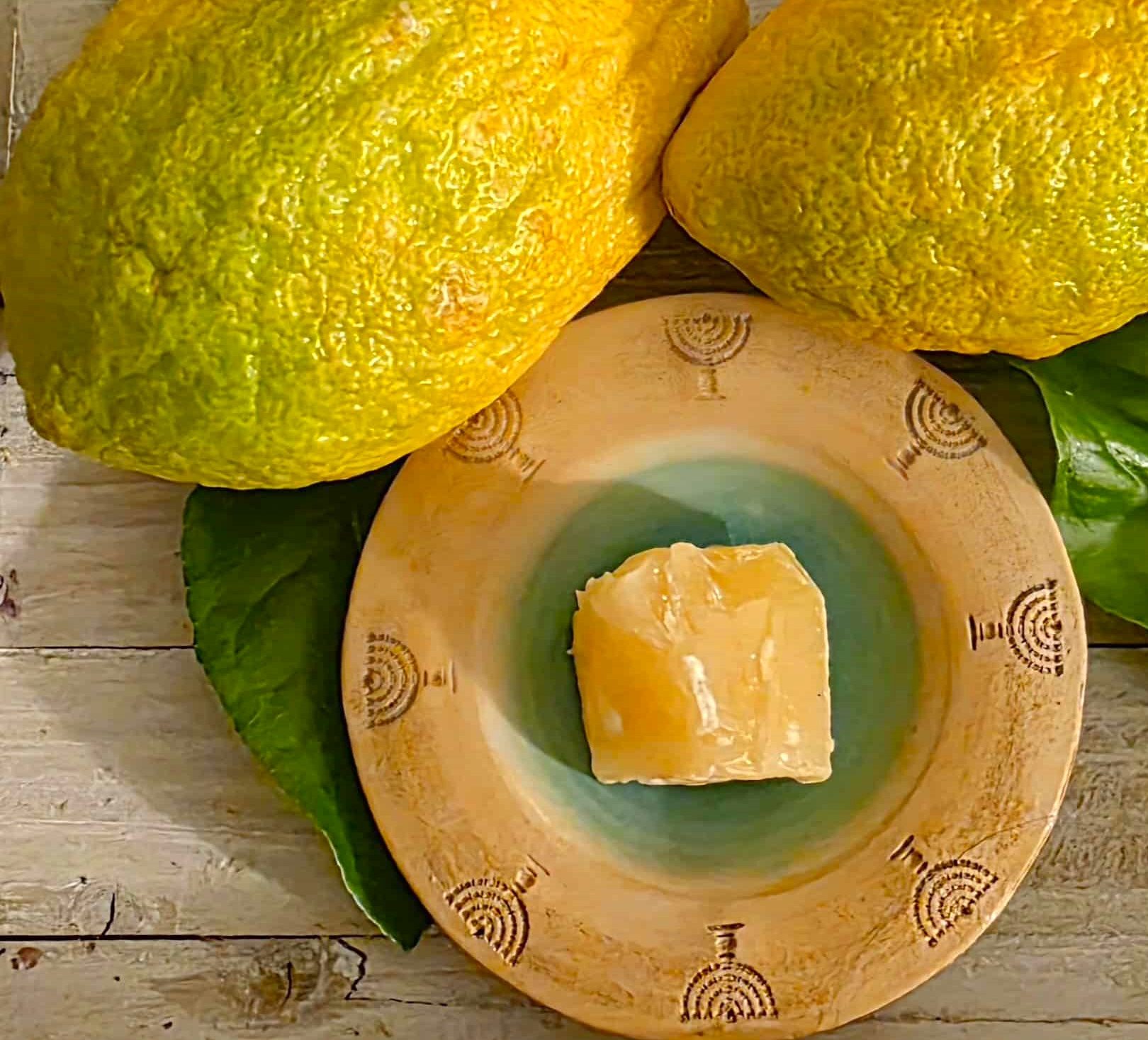
Etrog Citron Peel Botanical Wax
Aroma: Scent: Sweet, citrusy, zesty, powdery, deep, and very rich citron
Made in Israel
Extremely Rare
The true “Etrog” originates only from the Holy Land. The term “Etrog,” when used for any citron oil that is not sourced from Israel, does not represent authentic Etrog Citron©. Currently, there is only one producer of Etrog essential oil and other Etrog products, and it can be found in our apothecary. Our beautiful Etrog species are grown in Israel from seeds that are not Mirkov (grafted), in accordance with Jewish laws.
Fossilized pollen discovered at Ramat Rachel, south of Jerusalem, indicates that the Etrog citron fruit was cultivated in the Holy Land of Israel from the 5th to the 3rd century BCE. This suggests that the Etrog may have been present in Israel for over 6,000 years. The most likely origin of the Etrog is modern-day Iran, which was known as Persia. Both the Jews and Samaritans identify the Hadar fruit mentioned in the Torah as a citron, which resembles a lemon with a bumpy exterior. There is agreement on this identification between both communities.
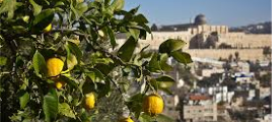
The Etrog Citron is a large lemon-style fruit that has a thick bumpy textured rind. The fragrance of this unique fruit helps to open a closed heart. Please note the finger-looking fruit by the species name Citrus medica var. sarcodactyl which is a hybrid is not to be mistaken for the true Etrog citron species full name Citrus medica vulgaris fruit from the Torah and fruit that is used during the week of Sukkot Holiday.
The aroma of Citron- Etrog (Pri Eitz Hadar) Low tempatures steam distilled essential oil from Israel is zesty and smells both sweet and tart as if green lemons were mingled with sweet mandarins in a citrus orchard
Antibacterial, anti-inflammatory, antioxidant, analgesic, and uplifting therapeutic actions when used externally.
Etrog (plural: etrogim, Hebrew: אֶתְרוֹג) is the yellow citron or Citrus medical vulgaris used by Jewish people during the week-long holiday of Sukkot, as one of the four species. Together with a Lulav, Hadas and Aravah, the etrog is to be taken in each Jewish hand.
Some Scholars say agriculturally Sukkot was the time to gather all your ripen fruits among these were the Etrog. There were so many fruits that instead of making long list verses of the Bible would call this beautiful fruit of the tree פְּרִי עֵץ הָדָר. Israel was abundant as it is today in Fruits. There are so many types of Etrog ie the Citron. See Leviticus 23:40 and examples of beautiful fruits in Nehemiah 8:15.
Citron – Etrog (Citrus medica): Zesty in the aroma like lemon, Etrog is uplifting and is anti-bacterial, anti-inflammatory, anti-oxidant, and analgesic.
“In order for a citron to be kosher, it must be neither be grafted nor hybridized with any other species. Only a few traditional varieties are therefore used. To ensure that no grafting is used, the plantations are kept under strict rabbinical supervision. Thus the reason Etrog Citron© only comes from the Holy Land of Israel. So anyone claiming they sell etrog Citron Essential oil is not the real Etrog Citron© oil.
“The Biblical phrase peri eitz hadar (פְּרִי עֵץ הָדָר) usually refers to the etrog in its original Aramaic Biblical name. Grammatically, the Hebrew phrase is ambiguous; it is typically translated as “fruit of a beautiful tree,” but it can also be read as “a beautiful fruit of a tree.” Etrogs are carefully selected for the performance of the Sukkot holiday rituals.” The word Etrog is an Aramaic word we find in the Hebrew Aramaic Targum. Etrog also became a symbol of Israel’s persistence for the right to exist in modern times.
In the writings of Josephus that a priest was pelted with Etrogim in the Temple because he did something that was extremely offensive by taking the water that was meant to cleanse the altar of sacrifice and pouring it on his feet instead, so he was pelted with etrogim and was run out of the Temple. Why Etrogim? The answer is most likely because it grew in abundance in Israel at that time in the First Century, and it was most likely at Sukkot when this occurred, when etrogim would have been harvested and used in Temple service.
The Etrog soon became a symbol in literature, paintings, and other forms of art to distinguish the Jewish people from the Samaritans. It’s important to remember that the Samaritans separated from the Israelites to practice their own form of worship on Mount Gerizim. For a glimpse into this conflict, one can read Ezra 4:1-6. The Samaritans do acknowledge that the Hadar is a citron grown in the Holy Land.
Etrog, according to the Sephardic pronunciation in Modern Hebrew pronunciation. The Ashkenazi pronunciation and in Yiddish is esrog or esrig, which is closer to Aramaic Hebrew pronunciation. The Hebrew word is thought to derive from the Persian name for the fruit, turung, likely borrowed via Aramaic.
The aroma of Etrog Citron Hadar) is both a cold-pressed peel and a steam-distilled essential oil from the fruit and peel from Israel and is zesty, refreshing, and smells both sweet and tart as if sweet-tart green lemons were mingled with sweet oranges, mandarins, and tangerines in a citrus orchard. The fragrance of this unique fruit helps to open a closed heart, heals the broken-hearted and grief, frees the mind from holding guilt.
Etrog refers to the heart, the place of understanding and wisdom.
Palm refers to the backbone, uprightness.
Myrtle corresponds to the eyes, enlightenment.
Willow represents the lips, the service of the lips (prayer).